
We often think that you have to be a genius to make great mathematical discoveries, and sure, genius probably plays a role, but did you know that there’s actually a pattern to making mathematical discoveries? And most likely, you’ve experienced this pattern yourself when studying mathematics. This pattern was found in a research done by mathematician Jacques Hadamard, in his paper “The Psychology of Invention in the Mathematical Field”. But, how do you actually study something like mathematical discovery in the human brain?
In the early 1900s, a pretty unknown mathematician named Edmond Théodore Maillet, sent out a questionnaire to his fellow mathematicians asking how they made their discoveries. It contained questions like
- Do mathematical solutions ever appear in your dreams?
- Do you stop working on problems and return later?
- How do your discoveries occur?
This was an interesting idea that got picked up by two psychologists Théodore Flournoy and Édouard Claparède who sent out a survey to mathematicians which contained 30 questions. I would personally be really curious to know the answers to these. They were something like:
3. Are you more interested in mathematical science per se or in its applications to natural phenomena?
7. What, in your estimation, is the role played by chance or inspiration in mathematical discoveries?
12. Before beginning a piece of research work, do you first attempt to assimilate what has already been written on that subject?
13. Or do you prefer to leave your mind free to not be biased, and only after thinking about the problem do you look up other research to see if you’ve made original contributions?
They even got into details like, how many hours should you sleep, how many meals should you eat, do you exercise, how many hours a day should you study, should you work on mathematics in the morning or evening, and so on.
Sounds like a pretty fun study right? Well the problem is that, and Hadamard points this out, barely any major mathematicians replied. The replies mostly came from mathematicians who are completely unknown. So from people who did not make any major discoveries in their careers. Only a couple answers came from people like Leonard Eugene Dickson and the even more famous Ludwig Boltzmann, but other famous names like Paul Appell, Gaston Darboux, Émile Picard and Paul Painlevé didn’t really bother replying.
So Hadamard argued that we need a better case study for answering these questions. After all, we need to learn from those who made significant mathematical discoveries – how and what were they thinking?
Hadamard actually sent out some questionnaires himself while preparing this essay. And one of them was to Albert Einstein, to which he actually got a reply and put it in the appendix. We will get back to Einstein later, but first, Hadamard directs us to study the thinking of a very important figure: Henri Poincare.
Poincare left us something very rare: a detailed description of how one of his discoveries actually happened.
Poincaré tells us that for two weeks straight, he was trying to prove that a certain kind of mathematical function could not exist. Basically, that that mathematical structure was impossible. Every day he would sit down at his table and try many many combinations, and none of them seemed to work.
And then, one day late at night, he took some black coffee, (which he says was unusual for him), and obviously couldn’t fall asleep. He kept on getting ideas in his head, until eventually a couple of them formed into one single and stable combination.
By morning, he actually ended up understanding that one kind of these functions did exist, even though the entire time he was trying to prove that they were impossible. He took a few hours to check his results, and ta da, he came up with one class of Fuchsian functions, the ones that are derived from the hypergeometric series.
But this wasn’t the “moment of clarity” part.
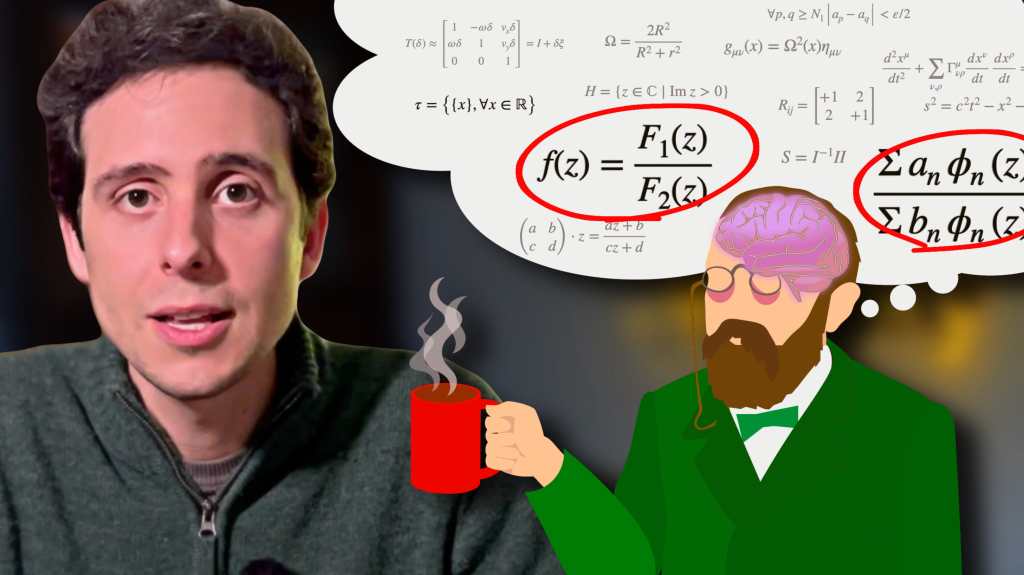
After realizing that these functions exist, he wanted to construct them explicitly, and decided to represent them as a quotient of two series, inspired by elliptic functions, which can be written in a similar way using theta functions.
So his reasoning was pretty much like this:
- Elliptic functions can be expressed using theta series.
- Maybe these new functions (which he later called Fuchsian functions) can also be written using a similar construction.
- If such series existed, what properties would they need?
- And once he determined those properties, he constructed the series explicitly.
Those became what he called Theta-Fuchsian series.
By the way, if you don’t understand some of the technicalities in his story, don’t worry about them too much, the point is his way of thinking.
Anyway, then, he had to take a break, because he had to visit a geological conference. He says this trip made him “forget” his mathematical work. One of those days, during a break, he went for a drive on a carriage. As soon as he set his foot on the step, a thought popped into his head: He immediately realized that the transformations he had been using to define his new functions were actually the same transformations that appear in non-Euclidean geometry. Even though he wasn’t thinking about it AT ALL or anything like it beforehand. He didn’t sit down to check his idea, but just continued whatever conversation he was having with people next to him, but he was absolutely sure that he was right. When he had the time, he found out that he was actually right. But that’s not all.
He came back home after the conference and started working on an unrelated mathematical problem in arithmetic, which he thought could be connected but wasn’t.
He became frustrated and went for a few days to a city by the sea, and says that he thought about completely different, unrelated things. As he was walking on a cliff, again the resolution suddenly popped into his head, out of nowhere. The arithmetic problem actually was connected.
He realized that two very different-looking things were actually governed by the same transformations:
1. Arithmetic transformations of indefinite ternary quadratic forms.
These are expressions where the coefficients allow the form to take both positive and negative values (so, “indefinite”), and the variables are three (that’s why it’s called “ternary”).
2. Transformations in non-Euclidean geometry
These are the transformations that move points around in hyperbolic geometry while preserving distances.
Poincaré realized that the same group of transformations appears in both. He came back home and verified the results, and continued thinking about it.
Like we said, don’t worry about the mathematics, but notice the pattern here. Although it’s nice to know the math right?
That’s why we have a catalogue of learning material, accompanied by our videos, where we go into more detail and give exercises with solutions.
We’re starting to pick up a pattern here, which Hadamard wants us to notice: that these ideas tend to come to Poincare subconsciously. Not while he was actively working on the problem, but after he had stopped, distracted himself with something else, and then it came back to him suddenly, like by accident.
Poincare gives other examples, like when he had to serve in the army, he stopped thinking about it, and then suddenly the resolution came to him, so, I think you get the point.
But here’s something Hadamard wants you to notice: it’s not like he’s just a genius and the solutions just drop from the sky on his head. Hadamard says that we have to go back to those two weeks of work, and to that sleepless night when Poincaré drank his black coffee. And only after did those thoughts “submerge” to his subconscious.
Of course Poincare’s experience seems to be something really special. Maybe because his brain works differently, or maybe because other mathematicians didn’t bother to write their experience down. Or did they?
Hadamard argues that this sort of pattern is actually a pretty common thing. He gives the example of Gauss, who after trying to prove a theorem in arithmetic for many years unsuccessfully, wrote that “like a sudden flash of lightning, the riddle happened to be solved. I myself cannot say what was the conducting thread which connected what I previously knew with what made my success possible”. It was a sudden insight. He gives a similar example of the German physicist Hermann von Helmholtz, and French physicist Paul Langevin.
And he doesn’t only list physicists and mathematicians, he gives the examples of chemist Wilhelm Ostwald, and the psychologist Graham Wallas, and even Mozart.
Honestly, even with me it happened many times. I am not saying I gave a great contribution to human knowledge, but sometimes I am trying to solve a problem and I just can’t do it. Then I leave it and dream with the solution, or with a part of the solution, and then when I wake up it turns out to be right. Sometimes it turns out to be wrong… but you get the point!
Hadamard established this pattern, but if you were reading his essay, at this point we would only be on page 19 out of 136, plus the appendix. So there’s something else we can learn from these great thinkers: how does the unconscious mind actually come up with these solutions? Like it’s not a magic thing that you just “leave it up to the unconscious and it figures it out”. That’s the actual deep question here: how does it work? When we take a break, why do we all of a sudden get enlightened?
Hadamard dedicates a lot of writing to the unconscious, and it’s an interesting read if you have the time, but here’s the main thing about it: how does the unconscious relate to discovering new ideas.
Hadamard argues that in whatever field, inventions and discoveries happen by combining ideas. The majority of the ideas that float around in our heads end up being useless. But, which of those floating ideas do we actually notice?
Hadamard says that our conscious mind only sees the combinations that are useful, or at least look promising. But for us to find those good ideas, our mind has to generate a huge number of possible combinations. When does the mind do it? When we’re not consciously thinking about it. Hadamard says that you won’t even know about all of the useless combinations because they were generated in the “unconscious mind”, only when one of those combinations turns out to be interesting does it suddenly appear in our conscious mind, and that’s the moment we experience an insight.
Hadamard discusses in what part of our mind this takes place, how the selection of meaningful ideas is guided by our sense of beauty, how some of the ideas originate with luck, how there are actually different kinds of mathematical minds, this video could go on for hours getting into the details. But the main takeaway is that there tends to be a map to coming up with great ideas: intense work → “incubation period” (basically when you stop thinking about it) → and finally illumination. The invention of new ideas is the selection of useful combinations from a huge space of possibilities, which Hadamard abbreviates in just five words: “to invent is to choose”.
Now, like we mentioned earlier, Hadamard sent out questionnaires himself to many scientists, but his personal favorite is of course, from Albert Einstein. Hadamard basically asked him what kind of “internal world” did he use to solve problems? Does he think visually? Use sound? Make some hand gestures in the air to help him imagine things? How does he come up with great ideas?
Well, Einstein answered in 5 points, all of which are pretty short and are an interesting read, but basically he says that the words or the language, as they are written or spoken, do not seem to play any role in his mechanism of thought, but that he uses images and combines them. Through playing with those images, he looks for interesting combinations and logical connections.
What do you guys think about Hadamard’s analysis? Have you personally had these “moments of enlightenment”?

 DiBeos
Leave a comment