
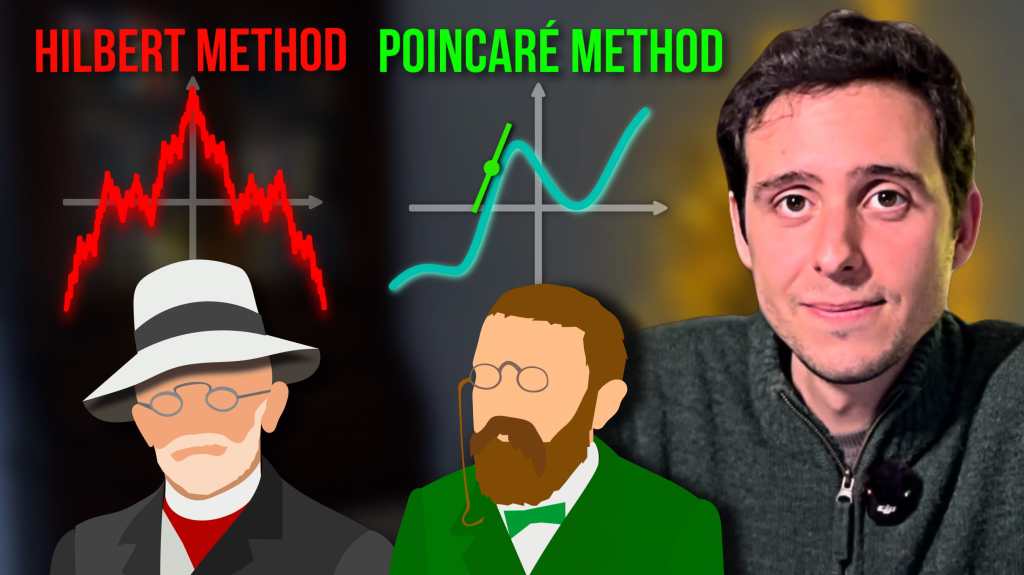
If I asked you to understand a mathematical proof, you would approach it in 1 of 2 completely different ways. That’s because mathematicians Poincare and Hadamard discovered that there are 2 kinds of mathematical minds: let’s see which one you have, and which one is better at helping you learn mathematics.
Let’s take a really simple and famous proof in arithmetic: Show that there are infinitely many prime numbers. How can we prove that?
Now stop right there. When I said that, what did you imagine? Did you imagine a sequence of numbers? Or did you see a full sentence of what I just said? Or was it some visual blob that makes sense in your mind?
Hadamard shared exactly what happened in his mind as he worked through the proof. Let’s see if you experienced something similar: we can start by proving that there is a prime greater than 11.
The first step of the actual proof is to consider all primes from 2 to 11. Now, Hadamard tells us that at that point, he just sees a confused mass.
The second step is to form their product. But in his head, Hadamard tells us that since N is some large number, he sees a point located far away from the confused mass.
The next step is to increase that product by 1, so N + 1. In his head, Hadamard sees another point, a little farther away from the first.
And finally the last step tells us that that number, if not a prime, has to admit a prime divisor, which is the required number. Hadamard grasps something much simpler: he sees a place somewhere between the confused mass and the first point.
The images in Hadamard’s head are not mathematical, he doesn’t actually think about primes or divisibility, or sees actual symbols, and so on. He also doesn’t think about specific steps, his thinking is really vague.
That’s what the intuitive mind thinks like, and the vast majority of people, and I include myself, think vaguely this way when we first encounter a problem, at least according to Hadamard.
To him, this vagueness is intentional and important, because if he tried to make it precise right away, he would most likely deceive himself or at least think up things which would turn out to be inaccurate.
Now that you have an idea of what an intuitive mind thinks, try again and see how you visualize this: consider a sum of an infinite number of terms, and estimate how large it is. In that case, there is a group of terms which is dominant, and all others have negligible influence.
Pay attention to how you visualized it. When Hadamard thinks of this question, he doesn’t see the formula itself. Instead, he sees a kind of ribbon, which is thicker or darker at the place corresponding to the possibly important terms; at other moments, he sees something like a formula, but not one that you can read, but like a blurry version, as if he was seeing it without his glasses.
But, Hadamard says that once he actually writes out the vague formula, it immediately becomes replaced by what he wrote out in his mind.
We’re starting to see a pattern here. He begins by holding a vague image in his head, which he calls a “schema”. Remember this word because we will be using it quite a bit. A schema is something that lets you grasp the whole idea at once. Now when he actually writes it down, he doesn’t need to keep the idea in his head anymore because he put it out there. And he continues to alternate back and forth between the two modes as he is thinking.
Hadamard sent out a questionnaire to many thinkers, and said that most of them had similar experiences to his. An interesting response came from Albert Einstein, who shared exactly how his thinking process goes “The words or the language, as they are written or spoken, do not seem to play any role in my mechanism of thought”… that they are “more or less clear images which can be “voluntarily” reproduced and combined”…and that this sort of thinking is essential “before there is any connection with logical construction in words or other kinds of signs which can be communicated to others.”
But, this kind of thinking is not true for everyone, and Hadamard gives the example of mathematician George Pólya.
Pólya told him that he believes “that the … idea which brings the solution of a problem is “… often connected with a well-turned word or sentence…”
So Polya pictures a word in his head, or a sentence. And gives much less value to schemas. Out of all of the mathematicians Hadamard talked to, he was the only one who reported it. But we know that there are other well documented cases of people who think exactly like Pólya, which were discussed in detail by a psychologist named Ribot, but that’s another topic.
You might think that the other kind of mind is the one that Pólya has, which is called the logical mind. And you’d be partially right, except that people with logical minds also use imagination and schemas, just like the intuitive minds, but they have a key distinction.
The key distinction is that, it’s not about how they think, but about what they trust. As natural as it is for us to think in schemas, there are mathematicians who are against this abstract, intuitive thinking process, one famous example is Rene Descartes.
Descartes admitted that it is pretty much impossible to get by without imagination, but, he strongly distrusts intuitive thinking, and he even tried to completely erase the use of imagination from science (even though he ended up being unsuccessful).
The best examples of Descartes’ thinking can be taken by looking at “modern” mathematicians, at least modern for Hadamard’s time, like David Hilbert. There’s a work by Hilbert, called Foundations of Geometry, where he tries to describe geometry without relying on intuitive thinking. Now before we show you guys, I have to tell you that it’s a heavy read, precisely because it’s not supposed to be easy for your mind to get. You’re not supposed to be using much imagination.
This work starts with “Let us consider three systems of things. The things composing the first system, we will call points; those of the second, we will call straight lines, and those of the third system, we will call planes”
We’re not supposed to ask what Hilbert means by the word “things”. All we have the right to know about them is that we should learn their axioms. Axioms like this for example: “Two different points always determine a straight line…Instead of ‘determine’ we may say that the straight line passes through these two points, or that it joins these two points, or that the two points are situated on the straight line.”
So basically that “being situated on a straight line” is the same thing as “determining a straight line”. The book is really good (in the sense that it is very complete and rigorous), but it’s not an easy read, and this is just the first page. It gets really complicated, really fast.
Hadamard says that from a logical point of view, Hilbert’s book works. Theoretically speaking, you can follow through the work without the need for geometric reasoning, it’s complete in itself.
But from the psychological point of view, is it really effective? Hadamard says that it is obviously not.
There is no doubt that while Hilbert was writing the work and thinking about it, he was constantly guided by his sense of geometry, whether he liked it or not. If you don’t believe Hadamard, just take a look at a few pages of Hilbert’s book: diagrams appear practically on every page. And even though logically they are not necessary, they are incredibly useful in helping the reader understand what he’s talking about.
Fine, but even though it’s inevitable for us to use our imagination, a logician would still say that it’s not something reliable, and the only thing we should pay attention to is the actual rigorous result. We should keep our intuitive ideas to ourselves, and only spread the actual rigorous and objectively true things. And they would be right to say that common sense can deceive us very easily.
Let’s imagine dropping a “material point”, a very small body like a marble. Common sense makes us assume that it will roll on a vertical plane, in a straight vertical line, because we don’t really have a reason for it to move left or right. Hadamard calls this the “principle of sufficient reason”.
So that’s how you might imagine it in your head, using common sense. But the mathematical proof is actually completely different. You won’t be able to use the argument of common sense, you have to instead use several theorems in differential and integral calculus.
Although as a side note, you technically could find a proof that is just like your common sense reasoning by applying a general theorem, where if you have a differential equation and with fixed initial conditions, you could find a unique solution.
Technically our common sense was right and there is a mathematical way to justify it. But here’s an example where it completely fails us:
Think of drawing a continuous curve in a plane. Common sense tells us that there are tangent lines at every point, and moving one of these lines along the curve determines some direction. Our common sense also makes us believe that it’s impossible for a continuous curve to not have any tangent at any point. But, as a matter of fact, this is false. Mathematicians can construct continuous curves that have no tangents at any point! This is better known as the Weierstrass function.
And of course we can list a lot more examples where common sense deceives us. This is where we’re going to pivot to what Poincare has to say about it, in his work Science and Method. Poincare says that in the past, mathematicians relied heavily on intuition. They assumed that a continuous function cannot change its sign without passing through zero, but today we proved that it actually can. They assumed many other things that were sometimes untrue.
And that’s because in the past, mathematicians used objects which were badly defined, but they thought they understood them because they represented them with their senses or their imagination. But in the end it was only a rough image, and that’s where the logicians are most important, and make their strongest point.
So there you have it: the two kinds of minds, the logical and the intuitive. So, what is the best approach? Poincare has an answer: rigor alone is not enough for real understanding or meaningful thought. The logical approach works beautifully theoretically speaking, but in practice, mathematicians don’t think in symbols, most of them think through “schemas” which let them “get it”. Without it, Poincare points out that “our theorems will be perfectly exact but perfectly useless.”
He also says that sometimes, “logic breeds monsters”, as in during his time when logic became prevalent, there were very weird functions springing up (like the Weierstrass function) that hold no resemblance to a regular function. And even stranger, from the point of view of logic, these weird functions are actually the most general cases, and smooth functions are the special cases of what it means to be a continuous function, because the smooth functions have more constraints.
Poincare says that earlier functions came from real problems, but now these new functions are just there to disprove the old functions, to show that the reasoning was flawed. And he believed that probably, that will be their only use – to show the fault of the reasoning.
If a teacher only had logic as their guide, says Poincaré, he would first have to start with the more general cases, and in our example, with the weird function, because the special cases, or what we know as regular functions, would only come later. So the beginner would first have to “wrestle with that monstrosity”.
That’s why we strongly believe that starting with intuition is the best approach to learn mathematics, even though later on rigor must replace intuition. So if you’re serious about learning and expanding your knowledge, using an intuitive approach, check out our catalogue of PDFs. Each of them comes with a YouTube video, and they are built on intuition, concrete examples, rigorous explanations, and (only then) exercises with detailed solutions, like this complete roadmap to Calculus, which I wish I had when I was studying it for the first time.
Well, let us know if you agree with Poincare and Hadamard, or if you think Descartes and Hilbert made a stronger point.

 DiBeos
Leave a comment